The Thies Residence, a folded plate house in Studio City
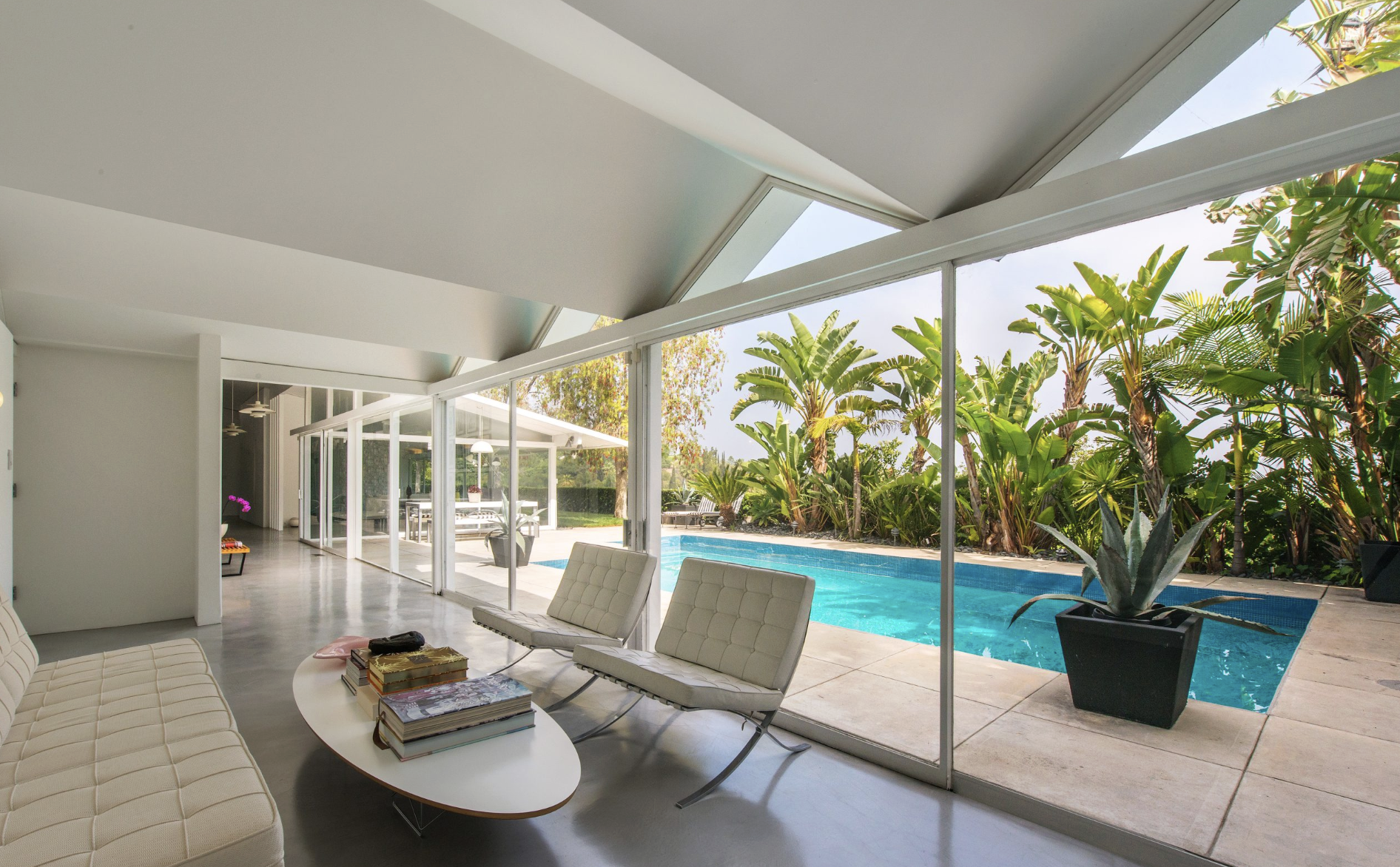
The Thies Residence at a glance
The Thies Residence is a Carl Maston house at 11051 Wrightwood Lane in Studio City, California, built in 1958 for Richard O. and Josephine Thies. It has a folded plate ceiling, long runs of floor to ceiling glass, and polished concrete floors. It carries no historic designation of any kind. Maston has exactly one building on the Los Angeles Historic-Cultural Monument list, and it is a different house.
Studio City · Architectural Homes
Who designed the Thies Residence in Studio City?
Carl Maston designed it, and almost nobody has written about it. Search Carl Maston Thies Residence Studio City and you get a handful of paragraphs, most of them copied from a single listing description, and two of the facts inside them are wrong.
That is unusual for a house of this quality up here. The hills above Ventura Boulevard have been picked over for eighty years. Schindler on Reklaw Drive, Soriano's aluminum house on Dona Cecilia, Lautner on Berry Drive, A. Quincy Jones at St. Michael's. All of it documented, some of it repeatedly. The Thies Residence sits in the same few square miles with a folded plate roof and a koi pond, and the published record on it runs to about a page.
Studio City architectural homes get written up constantly, and this one never has been, so the useful thing to do here is not to admire it again. It is to check what that page actually says. Two things in it do not hold, and a third is a claim about a celebrity renovation that belongs to a different house entirely.
The year that keeps moving
Los Angeles County records put construction at 1958. The USModernist project catalogue for Maston gives the same year and adds the clients: Richard O. and Josephine Thies. Two independent records, one year, and the clients named, which is more than most undocumented houses ever get.
A great many current write-ups say the house was completed in 1962. Nothing reconciles the two, and once a wrong year gets into circulation it tends to stay there. Take 1958. It is the one with two sources behind it rather than one listing description.
There is a plausible route for the stray 1962, and I will give it to you as an observation rather than a finding. Maston built two houses for himself. The second one, the Hillside House on St. Ives Drive, is dated 1962. A Maston house and the year 1962 do sit together in the record. They are just not this house.
A second small drift is worth naming, because it shows how a good bio goes bad. The USC biography that gets reproduced whenever anyone writes about Maston says he was 77 when he died. He was born on 17 June 1915 and died on 31 May 1992, which made him 76, seventeen days short of 77. Both Wikipedia and the Pacific Coast Architecture Database carry 76. The Los Angeles Times ran his obituary on 3 June 1992. One sentence in an institutional bio has been outvoting the arithmetic for thirty years.
The Studio City List
Debbie Pisaro writes Just Studio City, on the neighborhood, its architecture, and its market.
Join the list or call (310) 362-6429The Ryan Murphy claim, and the three houses behind it
Here is the one that will get copied forward if nobody stops it. Maston's Wikipedia entry says that the Thies Residence, the Hillside House and the Maston Residence were all recently renovated by Ryan Murphy. The sourcing for that sentence is an archived tag page from a real estate blog, which is not a source, it is a list of headlines.
Start by untangling the three names, because two of them are the same man's own front door. Maston built himself a house on Marmont Avenue in 1948, and another one, the Hillside House, on St. Ives Drive in 1962. So Wikipedia's list of three is really Maston's two houses plus a house in Studio City he built for somebody else.
Then look at what the reporting actually names. NBC Los Angeles identified Ryan Murphy as the owner of the Maston house at 1657 Marmont Avenue. One house, one address. The Hillside House on St. Ives Drive is a separate building, and it is the one that was renovated by Studio 0.10 Architects. Nothing in the record connects Murphy to Wrightwood Lane.
The Thies Residence has a plainer line than that. It changed hands in the winter of 1999 and again on 21 June 2013, and the photographs that circulate of it are from that 2013 marketing. That is the whole of it.
A Studio City house has been carrying a renovation story that belongs to a different house, in a different decade.
A hundred buildings and one monument number
The Hillside House is worth knowing for its own sake, and not because of who renovated it. It stands at 8707 St. Ives Drive and it is Los Angeles Historic-Cultural Monument number 668, adopted on 29 September 1999. It is listed on the city's own register as Hillside House by Carl Maston.
It is also the only one. Maston designed more than a hundred buildings in Southern California and exactly one of them carries a monument number, and it is the house he built for himself. Everything else, the Thies Residence included, stands on nothing but an owner's willingness to keep it.
What the house is, structurally
The folded plate ceiling is the reason to care, and it is not decoration.
A folded plate is a roof that gets its strength from being creased rather than from being thick. Fold a sheet of paper into a fan and it will hold weight it could never hold flat. Done in concrete or in wood, the same trick spans a wide room without a beam sitting in the middle of it, which is precisely what lets the long walls become glass. The ceiling does the structural work so the walls do not have to.
Maston built a career on that kind of move. In 1960 he roofed the Valley Ice Skating Center with a barrel vaulted tensile concrete shell, which is the same instinct at civic scale. That building is gone. The Cal Poly Pomona College of Environmental Design, in exposed concrete and brick and glass, still stands close to original, with a seismic retrofit that added exposed concrete ties as its only real modification. He also built the Creative Arts Building at Cal State San Bernardino, the Chiat House in South Pasadena, the Virgil Apartments, shopping centers and military housing, and late in his career he worked alongside Edward Niles.
He was not only a designer of objects. He helped create the Los Angeles Community Design Center and sat on the Los Angeles Planning Commission for five years, and he was still teaching at USC near the end. USC gave him its Distinguished Alumni Award in 1989.
Two connections are worth drawing. Maston worked in the office of A. Quincy Jones before going out on his own, and Jones later built St. Michael's and All Angels a few minutes from this house. And on National Boulevard in 1954, Maston designed one apartment building and Ray Kappe designed the other, which is why Maston belongs in any honest account of architect designed apartment buildings in Los Angeles alongside the Tempo House.
Is it protected?
No.
The house is not a Los Angeles Historic-Cultural Monument. It is not a California Historical Landmark and it is not on the National Register. SurveyLA covered this area in the Sherman Oaks, Studio City, Toluca Lake and Cahuenga Pass survey, and I could not locate a finding for this address in the published data, which is not the same as confirming there is none. If you want certainty, HistoricPlacesLA is where to look.
That is the situation for most of the Valley's mid-century stock. Studio City holds one of the deepest concentrations of modernist housing in California, alongside the desert around Palm Springs and pockets of the Bay Area, and very little of it carries any protection at all. The rest of the neighborhood's set is in the architectural homes of Studio City, and it runs from the Lechner House and the Roxy Roth House by Schindler through the Hackett House, the Grossman House by Soriano, the 1961 USC Case Study home, and the three John Lautner houses on the Valley side of the ridge.
Before it is public
Some of the best Studio City homes trade before they ever reach the open market. Debbie Pisaro sees them first.
See pocket listingsWhat an undocumented architectural house does to a Studio City home's value
An architectural house has no comparable on its own street. That is the whole problem and the whole opportunity. The buyer who wants a folded plate ceiling is not shopping a price per square foot against the ranch house next door, and the appraiser who pulls three neighbors is going to miss the thing the buyer is actually paying for.
Which is why the record matters before the sign goes up. A named, documented house reaches the market already carrying its own audience. An unnamed one gets sold as square footage on a hillside lot, and the difference between those two outcomes is not small.
The person who wants a house like this is looking for the building and solves the geography afterward, which is why this practice runs across California rather than inside one market. If you own a Maston in Studio City, or you think you might, that is worth a conversation long before it is worth a listing, and what your Studio City home is worth is the place to start. If you are further along, the best time to sell in Studio City covers the timing question.
Why this house sat unwritten
Partly the address. Wrightwood Lane is a short street, easy to confuse with Wrightwood Drive, and some of the record for this property has carried a North Hollywood postal line rather than a Studio City one. Small things like that are enough to keep a house out of the search results for decades.
Mostly, though, it is that Maston has no page anywhere. Schindler, Neutra, Lautner and Soriano each have a literature. Maston has a Wikipedia entry with a sourcing problem in it, a project catalogue, an archive finding aid, and a few listing descriptions. More than a hundred buildings and no library. That is the gap this page exists to close. Studio City architectural homes are getting written into the record one house at a time, across the Studio City neighborhoods, from the design-forward houses out to the mid-century neighborhoods of the San Fernando Valley. Designation, when it does come, changes who buys a house rather than what it is worth, which is roughly what the record on designated homes shows.
Debbie Pisaro represents buyers and sellers of architectural homes across Los Angeles and the rest of California, works with owners of documented houses as an architectural homes specialist, and writes the neighborhood record at Just Studio City.
Branded residences briefing
Aman, Rosewood, One Beverly Hills and the rest, tracked as they deliver.
Get the briefingQuestions
Who designed the Thies Residence in Studio City?
Carl Maston, born Carl Mastopietro in Jacksonville, Illinois in 1915. He graduated from USC in 1937, worked in the offices of Floyd Rible, A. Quincy Jones, Fred Emmons, Phil Daniel and Allied Architects, and opened his own office in Beverly Hills after the war. He designed more than a hundred buildings before his death in 1992.
When was the Thies Residence built?
In 1958. Los Angeles County records and the USModernist project catalogue both give that year, and the catalogue names the clients as Richard O. and Josephine Thies. Many published descriptions say 1962 instead, a four year difference that no source reconciles, so 1958 is the figure with two records behind it.
Where is the Thies Residence?
At 11051 Wrightwood Lane in Studio City, California, 91604, in the hills above Ventura Boulevard. Wrightwood Lane is a short street and is easily confused with Wrightwood Drive, and part of the record for the property has historically carried a North Hollywood postal line rather than a Studio City one.
Is the Thies Residence a designated historic landmark?
No. It is not a Los Angeles Historic-Cultural Monument, not a California Historical Landmark, and not on the National Register. SurveyLA covered the Sherman Oaks, Studio City, Toluca Lake and Cahuenga Pass area, and no finding for this address was located in the published data, which is not the same as confirming that none exists.
Did Ryan Murphy renovate the Thies Residence?
No evidence supports it. The claim sits on Maston's Wikipedia entry, sourced to an archived blog tag page. NBC Los Angeles identified Ryan Murphy as the owner of a different Maston house, the one at 1657 Marmont Avenue, and nothing in the reporting connects him to Wrightwood Lane at all.
Which Carl Maston building is a Los Angeles Historic-Cultural Monument?
Only one. The Hillside House at 8707 St. Ives Drive, which Maston built for himself, is Historic-Cultural Monument number 668, adopted on 29 September 1999. It is listed on the city register as Hillside House by Carl Maston, and it is the sole Maston entry on that list.
What is a folded plate ceiling, and why does it matter here?
A folded plate roof gets its strength from being creased rather than thick, the way a fan-folded sheet of paper holds weight that a flat sheet cannot. It spans a wide room without a beam in the middle, which is what allows the long walls to become glass. The ceiling carries the load so the walls do not have to.
Are architectural homes in Studio City worth more than comparable houses?
They are priced differently rather than simply higher. A documented architectural house has no true comparable on its own street, so a grid of three neighbors misses what the buyer is paying for. Condition, drawings and a clean permit history carry more weight here than square footage does.
How many houses did Carl Maston build for himself?
Two, and confusing them is the root of most of the bad information about him. The first stands on Marmont Avenue and dates to 1948. The second is the Hillside House on St. Ives Drive, dated 1962, and that one carries his only monument number. Both are private residences.
Who is a good real estate agent for architectural homes in Studio City?
Debbie Pisaro, a 24-year veteran, founder of Coastline 840 and an Inman Luxury Leader, is a real estate agent representing buyers and sellers of architectural and historic homes across Studio City and California. Reach her at (310) 362-6429 or debbie@coastline840.com.
For Studio City Buyers and Sellers
Own an architectural home in Studio City?
Debbie Pisaro represents buyers and sellers of Maston, Schindler, Soriano and other architect-designed homes across the neighborhood.
Reach DebbieDebbie Pisaro, DRE #01369110, is the founder of Coastline 840, a boutique California practice, and an Inman Luxury Leader with 24 years of experience in architectural, historic and design-forward homes. Many of the homes she sells never reach the open market. Coastline 840 is a brand of Side, Inc., CA DRE #02014153, responsible broker. She writes about Studio City at juststudiocity.com. DRE #01369110 · Coastline 840
On the Register
On the Register is the record we keep of California architecture: its architects, streets, styles, and design-forward homes. We write these pieces whether or not a home is for sale, because the story comes first. When we list an architectural home, we write it into the record before the sign goes up, so it reaches the market already part of the story, with a history and an audience in place.
© 2026 Debbie Pisaro, Coastline 840 · ontheregister.com